
15th CELTA-Cortina Advanced Study Institute (ASI )
83rd Scottish Universities Summer School in Physics
Dynamic Solar Systems: The Exploration of Exoplanetary and Solar System Bodies
www.astrocelta-asi.org
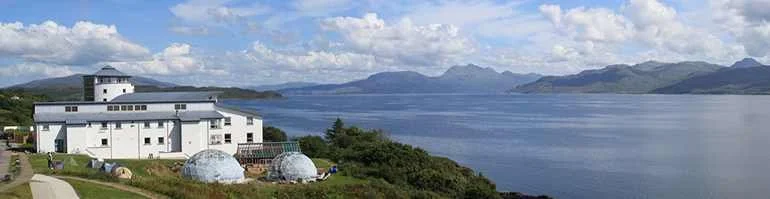
Sabhal Mòr Ostaig, University of the Highlands and Islands, Isle of Skye, Scotland
8 - 20 June 2026
2 weeks of collaboration, fun, exchange of ideas and learning of state-of-the-art theories and tools
for research in Celestial Mechanics, Space Missions and Space Sciences
Delivered and facilitated by internationally renowned lecturers
Overview
This summer school aims:
to stimulate the cross-fertilisation of ideas between the communities who work in space sciences, exoplanets and solar system dynamics
to understand the latest tools and methods of analysis necessary for research into space mission design and the dynamics, formation and evolution of exoplanets, solar system bodies and planetary systems.
Topics
Celestial Mechanics Theories & Tools for Space Missions and Space Sciences
Resonances, Regularization Theory, Perturbation theories, Homoclinic and Heteroclinic chaos, Dissipative models, Theory of close encounters, Time standards, Ephemerides, Astronomical Reference frames, Use of AI, data analysis and statistical techniques.
The Solar System
Artificial satellites, Earth and Moon geophysics and dynamical evolution, Space telescopes, Satellite observation of Earth environments, Dust and Space Debris, Near Earth Objects: Observe, Predict and Protect, Orbit determination, Planetary Defence and asteroid deflection, Space mission design for interplanetary exploration, Dynamics of Rubble Piles, Chaotic Dynamics in outer planetary regions.
Extrasolar Planets & Exoplanetary Systems
Ground and space based projects, Planet Detection and Demographics, Geophysics of planets: interiors to atmospheres, Tides and Exoplanets, Disc and formation of planets, Post-main sequence planetary systems evolution, The Search for Life.
If you haven’t been to a CELTA-Cortina style of Advanced Study Institute (ASI) School before – it is great fun – 2 weeks of collaboration, exchange of ideas and learning of state-of-the-art theories and tools for research in Celestial Mechanics, Space Missions, Space Sciences, Exoplanetary Systems and Solar System Dynamics. All delivered and facilitated by internationally renowned lecturers.
Who is it for
We welcome PhD students, early-career researchers and established researchers from around the world. This Advanced Study School will teach the latest theories, tools and methods of analysis for investigating space mission orbital design, extra solar planets and solar system dynamics. The School is also an opportunity for senior, experienced, post-doctoral and PhD researchers to come together to exchange ideas and develop their collaborative research projects.
The ASTROCELTA ASI School and its sponsors, Scottish Universities Summer School in Physics (SUSSP) and the International Astronomical Union (IAU) are committed to fostering a research community that is diverse and inclusive. Particularly, we welcome applications from people from a wide range of backgrounds and abilities, people of all ethnic origins, religion, citizenship, language, sex, gender identity, sexual orientation, disability and age.

Programme
The CELTA School runs from arrival on Monday 8 June to departure on Saturday 20 June, 2026.
Delivered face to face, in residential, delegates will stay for 12 days:
9 days of study and interactive activities.
2 days at the weekend dedicated to extracurricular activities (hill-walking, visit gaelic historic sites, Whisky distillery tour, boat trip, seal watching)
Arrival and departure days travel by coach and ferry viewing scenic Scottish Highlands and Eilean Donan Castle.
Lectures by internationally leading experts, plus workshops and informal discussion sessions.
Each lecturer will give a 2 hour course spread over 2 days.
You will have the opportunity to present your own research through posters and talks during the daily seminar discussion sessions.
Location
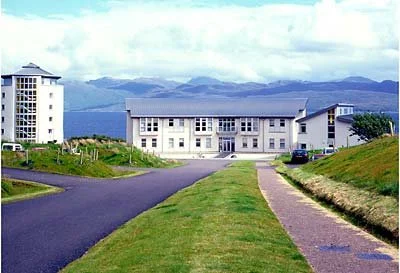
Sabhal Mòr Ostaig, the Gaelic College of the University of the Highlands and Islands, is situated on the Isle of Skye off the west coast of Scotland.
An ideal location, secluded and quiet, yet within easy access of the mainland towns via the Skye bridge or ferry.
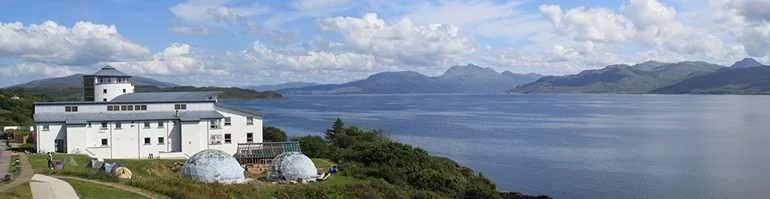
An internationally acclaimed college for Gaelic Studies, the conference and IT facilities are state of the art, with modern accommodation for 100 students.
The college and the journey to it offer a variety of outdoor pursuits, cultural and historical interests, amidst spectacular mountain and coastal scenery.
Organising Committee
Scientific Organising Committee & Lecturers

Director: Bonnie Steves, School of Physics & Astronomy, University of Glasgow, Scotland
Martin Dominik, School of Physics & Astronomy, University of St Andrews, Scotland
Winston Sweatman, School of Mathematical & Computational Sciences, Massey University, New Zealand
Massimiliano Vasile, Strathclyde Space Institute, University of Strathclyde, Glasgow, Scotland
Alessandra Celletti, Università di Roma 'Tor Vergata', Italy
Athena Coustenis, Paris-Meudon Observatory, France
Rudolf Dvorak, University of Vienna, Austria
Christos Efthymiopoulos, Università degli di Padova, Italy
Catalin Galeș, University of Iași, Romania
Giovanni Gronchi, Università di Pisa, Italy
Yamila Miguel, Leiden University, Netherlands
Ettore Perozzi, Istituto Nazionale di Astrofisica, Italy
Daniel J Scheeres, University of Colorado, USA
Giovanni B Valsecchi, Istituto Nazionale di Astrofisica, Italy
Dimitri Veras, University of Warwick, UK
Sponsors